
August 13, 2026
Wig Density Explained: 150% vs 180% vs 220%
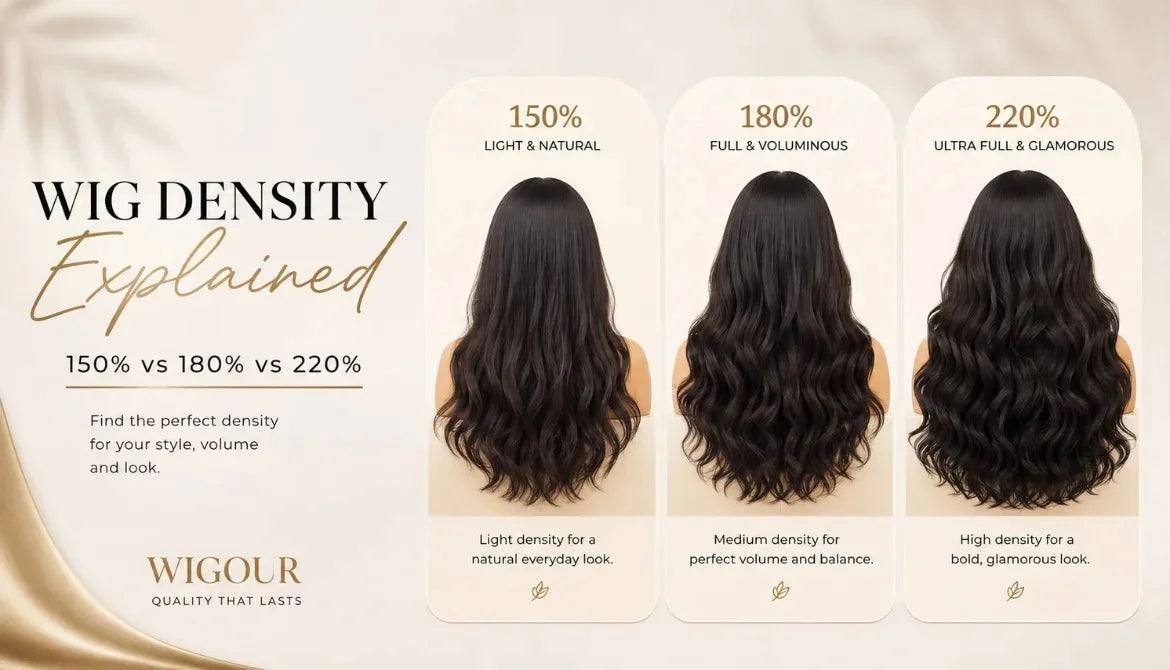
Density is the single most misunderstood number on a wig listing — and the one that decides, more than lace or length, whether a wig looks like your own hair or like a wig.
This guide explains what the percentages actually mean, how 150%, 180%, 220% and 250–300% look in real life, and how length and texture change the number you should be buying.
What Wig Density Actually Means
Density is the amount of hair sewn or tied into the cap, expressed as a percentage of a notional "full head". It has nothing to do with the thickness of individual strands and nothing to do with length.
For reference, average natural hair on an adult sits at roughly 100–120%. That is why a 150% wig already reads as slightly fuller than your own hair, and why 250% reads as a blowout.
Density Chart
| Density | Looks like | Best for |
|---|---|---|
| 130% | Light, slightly sparse | Very fine natural hair, short bobs |
| 150% | Natural, realistic | Everyday wear, first wigs, lace-heavy units |
| 180% | Full but believable | Most buyers; the safest all-round choice |
| 200–220% | Glamorous, voluminous | Long lengths, events, photos |
| 250–300% | Dramatic, red-carpet | Extra-long units, maximum impact |
150% Density: Natural and Everyday
150% is the closest to real hair. The scalp area looks believable, the lace lies flat because there is less weight pulling on it, and the unit is light enough to forget you are wearing it.
The trade-off is that at longer lengths the ends start to look thin. Past about 22 inches, 150% begins to taper noticeably.
Choose 150% if: this is your first wig, you want an undetectable everyday look, or you are buying a bob or shoulder-length unit.
180% Density: Full but Still Believable
180% is the most requested density we sell, and for good reason. It photographs well, holds a style, and still passes as natural hair on most people.
It is also the point where a wig stops looking flat in photos without tipping into obvious territory.
Choose 180% if: you want one wig that works for both work and nights out, or you are buying between 20 and 28 inches.
200–220% Density: Glamorous
At this level the hair is visibly thicker than most people's natural hair. It is the right call for long lengths, where the extra density stops the ends looking stringy.
Two things to know: it is heavier, so the cap needs to fit properly; and on a smaller head or finer frame it can read as a wig rather than as hair.
Choose 200–220% if: you are buying 28 inches or longer, or you want visible volume.
250–300% Density: Maximum Fullness
This is the red-carpet end of the range. There is noticeably more hair per square inch, which is what creates that salon-blowout body from root to tip.
High-density units carry real weight, so an adjustable glueless cap with proper straps matters more here, not less. Browse 300 density wigs.
How Length Changes the Density You Need
This is where most buying mistakes happen. Hair thins towards the ends, and the longer the unit, the more "end" there is to fill.
- Up to 18 inches: 150% is plenty
- 20–26 inches: 180% is the sweet spot
- 28–34 inches: 200–220%
- 36–42 inches: 220% minimum, 250–300% for a full look
A 150% unit that looks perfect at 16 inches will look see-through at the bottom at 36. See our 40 inch wigs for how this plays out at the longest lengths.
How Texture Changes It Too
Curl pattern creates volume on its own, so the same density reads differently across textures:
- Straight shows density most honestly — it needs the most
- Body wave needs slightly less than straight for the same visual fullness
- Deep wave looks full at 180%
- Curly looks full at 150–180%; above 220% it can look costume-like
Four Density Mistakes to Avoid
- Buying high density for a small frame. Volume should be in proportion to your head and shoulders, or it reads as a wig instantly.
- Buying low density in a long length. The most common regret we hear.
- Assuming density fixes a thin hairline. It does not — a pre-plucked hairline and good lace do.
- Ignoring weight. A 300% 40-inch unit is a real weight on the cap. Make sure the straps and combs are up to it.
Frequently Asked Questions
Can density be reduced after buying?
Yes. A stylist can thin a wig carefully from underneath. It cannot be added, so if you are unsure, buy the higher density and thin it rather than the other way round.
Does higher density mean better quality?
No. Density is a style choice, not a quality marker. Quality comes from the hair grade — 100% Remy human hair with aligned cuticles — and the lace.
What density looks most natural?
150–180% for most people. Natural hair sits around 100–120%, so anything above 220% is deliberately fuller than real hair.
Is high density heavier to wear?
Yes, though less than people expect. Most long units sit between 300 and 450 grams and the weight spreads across the whole cap. A properly adjusted glueless cap carries it comfortably for a full day.
What density do most people buy?
180%. It is full enough to look styled and light enough to look real.
Shop by Density
Every unit at Wigour is 100% Remy human hair on pre-plucked HD lace with an adjustable glueless cap:
- All human hair wigs — 150% to 220%
- 300 density wigs — 250% and above
- Glueless wigs — adjustable caps that carry high density comfortably
Free US shipping, processed in 1–2 business days and delivered in 3–5, with 30-day returns.