
March 31, 2026
Guide to Washing and Revitalizing Wig
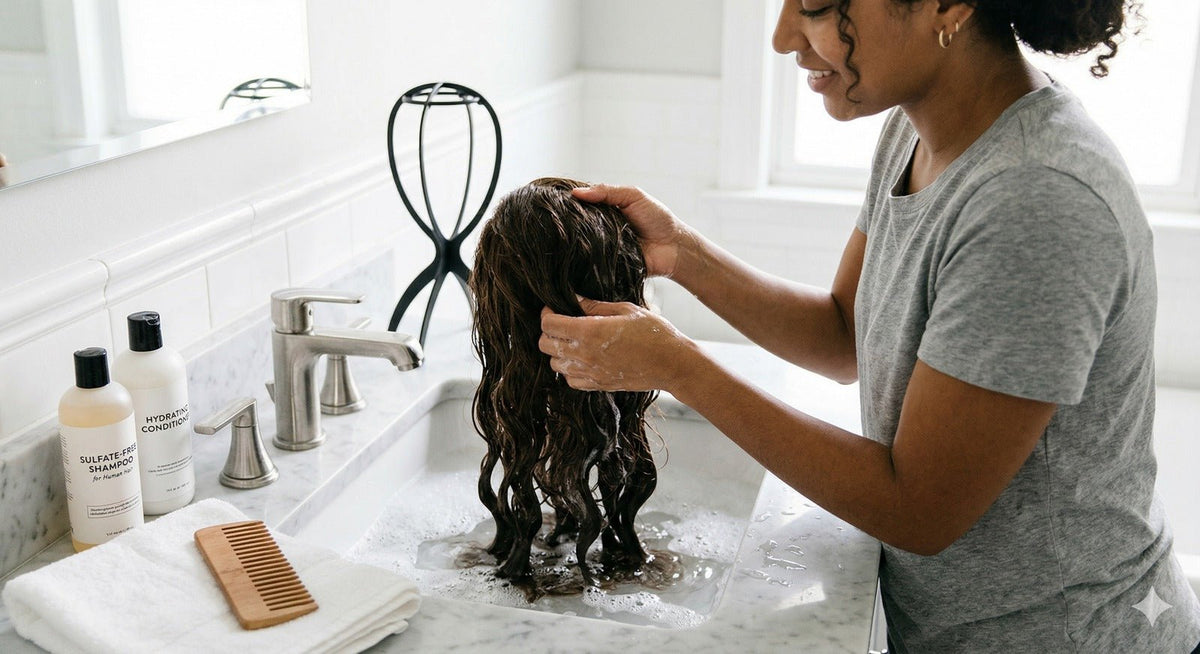
Washing a wig is significantly different from washing natural hair. Because wig fibers (even human hair) do not receive natural oils from the scalp, they require specialized care to prevent tangling, matting, and dryness.
1. De-Tangling: The Essential First Step
Never wet a tangled wig. This can tighten knots and lead to shedding.
- The Tool: Use a wide-tooth comb or a dedicated wig brush.
-
The Technique: Start from the ends and work your way up to the roots in small sections. For curly units, use your fingers to preserve the pattern.
2. The Rinse: Temperature Matters
- The Water: Use cool to lukewarm water. Hot water can damage the fibers and loosen the adhesive in the lace or the construction of the cap.
-
The Flow: Hold the wig by the cap and let the water flow from the roots to the ends. Do not soak the wig in a sink, as this encourages tangling.
3. Cleansing Without Stripping
- Shampoo Choice: Use a sulfate-free, paraben-free shampoo specifically formulated for wigs or color-treated hair.
- The Application: Distribute a small amount of shampoo through the hair using a downward stroking motion. Do not rub or massage the hair, as this causes friction and frizz.
-
Lace Care: Gently clean the inside of the cap and the lace area where adhesive residue may have accumulated.
4. Deep Conditioning & Hydration
- Avoid the Roots: Apply a high-quality conditioner from the mid-shaft to the ends. Avoid applying conditioner to the knots (the base of the cap), as it can cause them to loosen and the wig to shed.
-
Pro Tip: For human hair wigs, leave the conditioner on for 5–10 minutes to allow the moisture to penetrate the cuticle.
5. Drying for Longevity
- The Blot: Wrap the wig in a microfiber towel and gently pat it. Never wring or twist the hair.
- Air Dry vs. Blow Dry: Whenever possible, air dry your wig on a folding wig stand. If you must blow-dry, use the coolest setting and a heat protectant spray.
Tools to revive your wig
Bring your unit back to life with our detangling brushes, leave-in sprays and shine serums, and when a unit is past saving, find a replacement in our human hair wig collection.